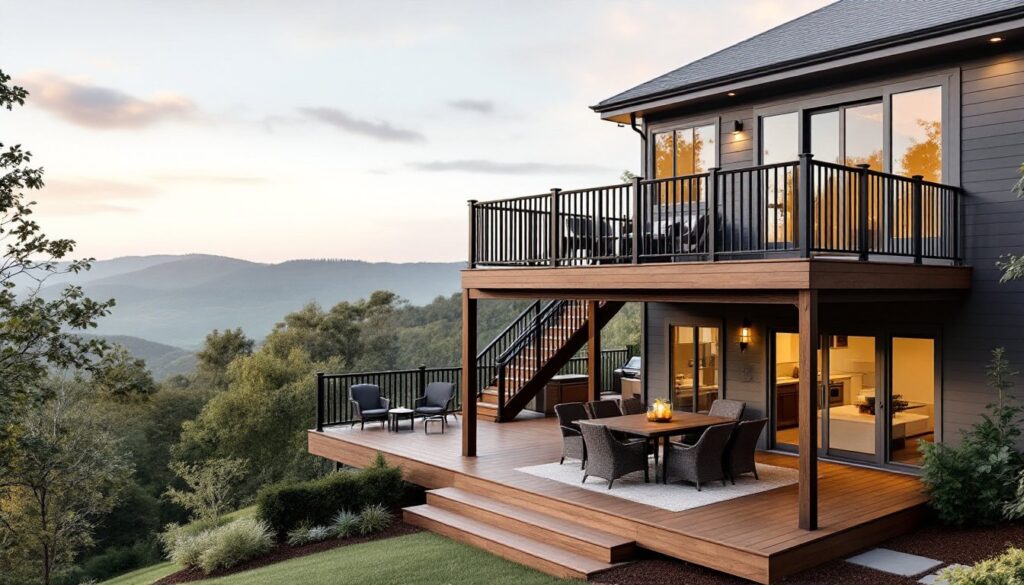
A two-story deck doesn’t just add outdoor space, it creates distinct living zones, improves home access, and can turn a sloped lot into a major asset. Whether connecting upper-floor bedrooms to outdoor air or maximizing a hillside view, multi-level decks demand careful planning around structural loads, code compliance, and material choices. Done right, they become an architectural feature that enhances both curb appeal and property value. This guide walks through design options, material decisions, safety requirements, and functional layouts to help homeowners and builders tackle a two-story deck project with confidence.
Key Takeaways
- Two-story deck ideas solve sloped lot challenges while creating distinct living zones and improving property value by offering multi-level outdoor living spaces.
- Upper deck guardrails must be at least 42 inches high with posts through-bolted to rim joists, and all stairs require consistent riser heights within ⅜ inch to meet safety codes.
- Composite decking and underdeck drainage systems enhance durability and functionality, though engineers must recalculate load capacity since composite materials weigh approximately 2.5 pounds per square foot compared to wood.
- Wraparound and stacked deck configurations each serve different home layouts—wraparound suits split-level homes with natural floor stagger, while stacked designs work best for hillside properties with multiple walk-out doors.
- Proper ledger board flashing with ½-inch lag screws every 16 inches and self-adhering membrane prevents water intrusion and catastrophic rot, making it one of the most critical installation details.
- Footings must extend below frost line (36–42 inches in northern climates) and may need to be 16 inches or larger for two-story builds to prevent settlement and structural failure.
Why Choose a Two Story Deck for Your Home
Two-story decks solve specific site challenges that single-level platforms can’t address. Homes built on slopes or those with walk-out basements gain usable outdoor square footage without extensive grading. Upper decks tied to second-floor doorways eliminate the need to trek downstairs for morning coffee or evening views.
From a structural standpoint, a two-story deck can sometimes share footings and posts with a lower platform, reducing excavation and foundation work, though engineers must verify load paths meet IRC requirements for combined live and dead loads. Safety codes become stricter: guardrails must be at least 42 inches high on the upper level (versus 36 inches for ground-level decks), and stair treads and risers need uniform dimensions to prevent trips.
Property value often gets a boost. Outdoor living space appeals to buyers, and a well-executed multi-level deck signals quality construction. The key is ensuring the project isn’t over-built for the neighborhood: a $40,000 two-story composite deck on a modest ranch may not recoup costs at resale.
Permit requirements are non-negotiable. Most jurisdictions treat decks over 30 inches above grade as structures requiring stamped plans and inspections. Two-story builds almost always trigger this threshold, and inspectors will scrutinize footing depth, ledger attachment, and guardrail load resistance.
Design Styles and Layout Options for Multi-Level Decks
Wraparound and Connected Deck Configurations
Wraparound designs follow the home’s footprint, creating a seamless flow from room to room. One common layout places a small upper deck outside a primary bedroom, then steps down 16–20 inches to a wider lower platform accessible from the main floor or basement. This configuration works well on split-level homes where floor heights naturally stagger.
Connecting stairs become a design feature. Straight runs save space but can feel utilitarian: L-shaped or switchback stairs add visual interest and provide landing spots for potted plants or seating. Stair width should be at least 36 inches for comfort, and building codes require a landing every 12 feet of vertical rise.
Another option is cantilevered upper decks that overhang the lower level. This approach maximizes shade below and creates a covered area for outdoor furniture. Cantilevers require engineered joists, typically 2×10 or 2×12 lumber doubled up, and should extend no more than one-quarter the joist span to maintain structural integrity.
Stacked Deck Designs With Independent Access
Stacked decks sit directly above one another, each with separate stairways to grade. This layout suits homes with both upper and lower walk-out doors, common in hillside construction. The upper deck’s underside becomes the lower deck’s “ceiling,” so joist spacing and decking thickness affect aesthetics below.
Independent access means each level functions autonomously. The lower deck might host a grilling station and dining area, while the upper deck remains a quiet retreat. Post placement becomes critical, columns supporting the upper deck must align with the lower deck’s beam system to transfer loads efficiently to footings.
Underdeck drainage systems are worth considering. Products like Trex RainEscape or TimberTech DrySpace channel water away from the lower level, keeping the space beneath the upper deck dry enough for storage or additional seating. Installation happens during framing, with panels sloping toward gutters at the deck’s perimeter.
Material Selections for Durability and Aesthetics
Structural framing for two-story decks almost always uses pressure-treated lumber rated for ground contact (.60 PCF retention for posts and beams). Joists can be standard .40 PCF treated lumber, but span tables matter more on upper levels where loads accumulate. A 2×10 joist at 16-inch centers might span 13 feet for a ground-level deck but may require closer spacing or a larger dimension when supporting an upper platform.
Decking material affects both weight and maintenance. Pressure-treated southern yellow pine is economical and proven, but it requires annual staining or sealing. Composite decking (brands like Trex, TimberTech, or Fiberon) eliminates splinters and rot but adds weight, roughly 2.5 pounds per square foot versus 1.8 pounds for wood. Engineers must account for this in load calculations.
For railings, aluminum or vinyl systems offer low maintenance and meet code without custom fabrication. Cable rail systems provide unobstructed views but require tensioning every season and posts spaced no more than 4 feet apart to prevent cable sag. Traditional wood balusters work fine but need spacing under 4 inches to meet IRC guardrail codes.
Flashing and ledger boards deserve extra attention. The upper deck’s ledger must be through-bolted into the home’s rim joist with ½-inch lag screws or bolts every 16 inches, with self-adhering flashing membrane behind it to prevent water intrusion. Skipping this step invites rot and catastrophic ledger failure.
Creating Functional Zones on Each Level
Two-story decks shine when each level serves a distinct purpose. Upper decks often prioritize views and quiet, think morning coffee nooks or reading corners with overhead pergolas for shade. Lower levels handle the heavy lifting: grills, outdoor kitchens, dining tables, and fire pits.
Size matters for functionality. A dining table for six needs at least 10 × 10 feet of clear space, while a built-in bench with storage underneath can define a zone without eating floor area. Upper decks can be smaller, 8 × 12 feet is enough for a pair of lounge chairs and a side table, since they’re not hosting groups.
Built-in features add polish. Benches with hinged seats provide hidden storage for cushions or garden tools. Planter boxes integrated into railings soften the look and add greenery without cluttering the deck surface. On lower levels, consider a raised platform within the main deck for hot tubs, this creates a visual boundary and simplifies plumbing access.
Lighting transforms usability after dark. Low-voltage LED systems are DIY-friendly and energy-efficient. Install post-cap lights on railings, recessed lights on stair risers, and strip lighting under bench seats. A transformer rated for outdoor use should be mounted near an exterior outlet, and wire runs should stay under 100 feet to prevent voltage drop.
Safety Features and Building Considerations
Guardrails on two-story decks must withstand a 200-pound concentrated load applied at any point along the top rail, this isn’t optional. Posts should be 4×4 lumber or larger, through-bolted to rim joists or blocking, not just toenailed. The top rail must sit at least 42 inches above the deck surface for upper levels, and balusters can’t allow a 4-inch sphere to pass through.
Stairs require precision. Riser height must stay consistent within ⅜ inch across the entire run: even small variations cause trips. Treads should be at least 10 inches deep, and a graspable handrail is mandatory on at least one side for any stairway with more than three risers. Handrails must be 34–38 inches above the stair nosing.
Footings need to reach below frost line, 36–42 inches in northern climates, 12–18 inches in southern zones. Each footing supports a post, which carries a beam, which in turn holds joists. Undersized footings lead to settlement and structural sag. Use 12-inch diameter footings for single-story decks: two-story loads may require 16-inch or larger, especially in soft soils.
Fire-rated materials may be required in wildfire-prone areas. Some jurisdictions mandate Class A fire-rated decking and prohibit wood within certain distances of the home. Check local codes early, switching materials mid-project is expensive.
Finally, always wear safety glasses when cutting lumber, hearing protection with power saws, and work gloves when handling treated wood. Two-story deck builds involve working at height, so fall protection, harnesses and secure ladders, becomes essential once framing rises above 6 feet.