Adding a fireplace to a basement turns a cold, underused space into a destination room. Whether finishing a raw basement or upgrading an existing rec room, a fireplace provides both warmth and visual weight, anchoring furniture arrangements and giving the eye a natural focal point. Unlike living rooms with existing chimneys and structural provisions, basements require careful planning around venting, clearances, and local code. The good news: modern electric and direct-vent gas units have made basement fireplaces more accessible than ever, with options ranging from plug-and-play inserts to sleek linear designs that rival high-end architecture. This guide walks through the most practical fireplace ideas for basements, covering installation considerations, design styles, and layout integration to help homeowners make informed decisions before the first wall gets framed.
Key Takeaways
- Basement fireplace ideas transform cold, underused spaces into destination rooms by providing supplemental heat and creating a visual anchor that guides furniture layout and room design.
- Electric fireplaces offer the easiest installation for basements, requiring only a 120V outlet with no venting, while gas fireplaces deliver higher heat output and realistic flames at the cost of more complex installation and permit requirements.
- Corner, linear, and wall-mounted fireplace designs solve different basement challenges—corner units activate awkward spaces, linear models suit modern aesthetics, and mounted units work in tight or unconventional layouts.
- Proper planning around venting, clearances, code compliance, and substrate preparation is essential before installation, with electrical and gas rough-ins best coordinated early in the framing stage.
- Material selection and layout strategy matter as much as the fireplace type itself; light-toned surrounds, balanced furniture arrangement, and strategic placement transform the fireplace into a unified focal point that enhances the entire basement.
Why Add a Fireplace to Your Basement?
Basements sit below grade, where concrete foundations wick cold and humidity year-round. A fireplace addresses both comfort and function. It adds supplemental heat to a space that HVAC systems often struggle to reach evenly, especially in older homes with undersized ductwork.
Beyond temperature, a fireplace provides a design anchor. Basement layouts can feel amorphous, large open rectangles with low ceilings and few architectural features. A fireplace gives the room a center of gravity, whether it’s flanked by built-ins, positioned opposite a sectional, or tucked into a corner nook.
It also signals intent. A basement with a fireplace reads as a finished, intentional living space rather than leftover square footage. This matters for resale value and for how the household actually uses the room. Families gravitate toward warmth and light: a fireplace makes the basement a place to spend time, not just store boxes.
Finally, modern fireplaces require far less infrastructure than traditional wood-burning units. No masonry chimney. No major structural modifications. Many gas and electric models install in a weekend, making them viable for remodels and DIY-friendly for homeowners comfortable with basic framing and electrical work.
Electric Fireplace Options for Easy Installation
Electric fireplaces are the simplest basement option, requiring only a standard 120V outlet and no venting. They use LED flame effects and either fan-forced or infrared heating elements to warm spaces up to 400 square feet.
For basements, three formats dominate:
- Insert units that drop into framed openings and trim out with a surround (ideal for built-ins or media walls)
- Mantel packages that arrive as complete freestanding units, ready to place and plug in
- Wall-mounted models that hang like flat-screen TVs, offering a modern, floating look
Installation typically involves framing a 2×4 box to the manufacturer’s rough opening specs, running a dedicated 15-amp circuit if the existing outlet is shared, and securing the unit per the manual. No permits are required in most jurisdictions since there’s no combustion or venting.
Pros: Low upfront cost ($300–$1,500 for mid-range units), zero clearance to combustibles in many models, and adjustable flame brightness independent of heat output.
Cons: Heat output is modest compared to gas. The flame effect, while improved, lacks the depth of real combustion. Cheaper units can look obviously artificial in bright light.
Electric fireplaces shine in basements with limited ceiling height, no exterior wall access, or where adding gas lines is cost-prohibitive. They’re also code-friendly for bedrooms and rental suites, where gas fireplaces may face restrictions.
Gas Fireplace Designs for Modern Basements
Direct-vent gas fireplaces offer the most realistic flame and the highest heat output, typically 20,000–40,000 BTUs. They draw combustion air from outside and exhaust through a sealed coaxial vent, meaning they don’t require a traditional chimney.
Installation requires access to an exterior wall (or a vertical chase to the roof) and a gas supply line. If the basement has an exterior wall above grade, horizontal venting is straightforward: the vent pipe exits through the rim joist or foundation wall, terminating outside with a capped vent. Below-grade installations need vertical venting, which adds cost and planning.
Permit requirements: Most jurisdictions require a permit and inspection for gas appliance installations. The work must meet International Fuel Gas Code (IFGC) standards, including proper venting termination distances from windows, doors, and air intakes. Homeowners comfortable with gas work can DIY in some areas, but many opt for a licensed plumber or HVAC tech to handle the gas line and final connection.
Design styles for basements:
- Traditional inserts with ceramic logs and refractory brick liners that mimic masonry fireplaces
- Contemporary linear models with glass media (crushed glass, river rock, or driftwood) and minimal trim
- See-through units that open to two rooms, creating sightlines between a media area and bar or game room
Gas fireplaces excel in finished basements where the homeowner wants zone heating without ductwork modifications. They also hold resale appeal: buyers recognize gas as a premium feature compared to electric.
Creating a Cozy Corner with a Corner Fireplace
Corner fireplaces solve a common basement challenge: how to activate awkward, unused corners without blocking circulation or cutting up the floor plan.
Most corner units feature angled glass fronts with viewing areas on two adjacent sides. They’re available in both gas and electric formats, with gas models requiring corner venting (45° angle vent pipes) and electric models needing only framing and power.
Installation starts with framing a corner chase: two walls meeting at 90°, with studs on 16-inch centers. The fireplace sits at the apex, and the walls extend outward to create the angled face. Finish with drywall and a corner mantel shelf, or go minimal with a clean tile surround.
Layout advantages:
- Frees up long walls for TV mounting or large furniture
- Creates natural separation between zones (seating area vs. play space) without full-height dividers
- Adds visual interest to flat, rectangular basements
Pro tip: Corner fireplaces work best in basements with at least 8-foot ceilings. In low-ceiling spaces (7 feet or less), the angled geometry can feel cramped. If ceiling height is tight, a standard wall-mounted or insert unit reads cleaner.
Pair a corner fireplace with flanking built-in shelving or a floating corner bench to maximize the nook effect. This setup is ideal for reading areas, home offices, or intimate conversation zones away from the main seating.
Linear and Wall-Mounted Fireplace Styles
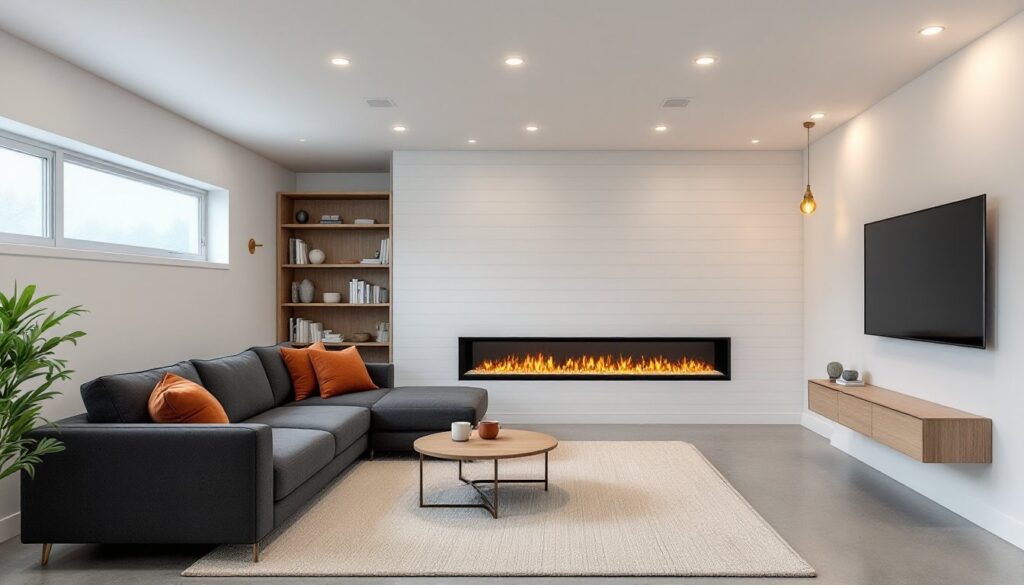
Linear fireplaces (also called ribbon or horizontal fireplaces) run wide and shallow, with aspect ratios ranging from 2:1 to 6:1. Widths commonly range from 40 to 80 inches, with depths under 6 inches for wall-mounted electric models.
These units suit modern and contemporary basements where the goal is clean lines and minimal visual clutter. They often install flush with the wall, trimmed with metal or stone, and positioned at eye level or higher, sometimes spanning the width of a sectional or media console.
Electric vs. gas linear models:
- Electric: Simple mounting bracket, hardwired 120V or 240V connection, no venting. Flame effects use LED strips behind glass media. Heat is secondary: many homeowners run these year-round for ambiance.
- Gas (direct-vent): Higher BTU output, realistic flame, but requires venting and gas line. Installation is more invasive, expect to open walls for vent routing and gas piping.
Design considerations:
Linear fireplaces pair well with horizontal materials, stacked stone ledger panels, large-format tile, or shiplap accent walls. Avoid busy patterns that compete with the flame line.
Height matters. Mounting too low makes the unit feel like a baseboard heater. Too high (above 60 inches to the bottom edge) strains neck angles when seated. The sweet spot for most basement seating is 36–48 inches off the finished floor.
Safety note: Linear gas units generate significant surface heat. Maintain code-required clearances to combustibles (typically 6 inches to framing, but always verify in the manual). Tempered glass fronts stay hot during operation, critical in basements with kids or pets.
Design Tips for Integrating a Fireplace into Your Basement Layout
The fireplace’s position and surround dictate how the rest of the basement arranges itself. A few layout strategies:
Anchor a media wall. Frame the fireplace into a built-in unit with flanking cabinetry, open shelving, or a TV niche above (if the unit allows it, check clearances). This creates a single focal wall and consolidates wiring for cable, outlets, and speakers.
Define a seating zone. In large basements, use the fireplace to mark a distinct living area separate from a bar, game table, or gym equipment. Rugs, furniture arrangement, and sightlines to the flame naturally define the zone without needing walls.
Balance asymmetry. If the fireplace sits off-center due to vent routing or structural obstacles (like a support column), balance it with a tall bookcase, a large piece of art, or a floor-to-ceiling window treatment on the opposite side. Symmetry isn’t required, but visual weight should feel distributed.
Material selection. Basements already run cool and dark. Avoid heavy, dark stone surrounds unless the room has abundant lighting and warm finishes elsewhere. Light-toned tile, painted brick, or wood-look panels keep the fireplace from feeling like a cave mouth.
Clearances and codes. Even non-combustible units have clearance requirements. For gas, allow space above for mantel depth (typically 6–12 inches depending on projection). For electric, confirm the unit’s heat outlet doesn’t blow directly into drywall returns or cabinetry.
Prep work matters. If mounting on a foundation wall, ensure the surface is flat and dry. Masonry walls may need furring strips and foam board insulation before drywall. Framed walls should use moisture-resistant drywall (purple board or greenboard) in basements prone to humidity.
Finally, plan electrical and gas rough-ins early. It’s far easier to run conduit and lines before drywall goes up. Coordinate with the electrician or plumber before framing so chases and outlet boxes land where the fireplace manual specifies.
Conclusion
A basement fireplace transforms square footage that often sits cold and ignored into a room people actually want to use. Whether choosing the simplicity of an electric insert or the performance of a direct-vent gas model, the key is matching the fireplace type to the basement’s infrastructure, layout, and intended use. Plan for venting, permits, and clearances early. Frame accurately. And remember: a fireplace is only as good as the space it anchors, invest time in layout and surround design to make the whole room work together.