Many homeowners in Bangkok’s older, established neighborhoods begin a renovation with a fixed budget and a clear vision, only to watch both expand the moment contractors open the first wall. Aging wiring, outdated plumbing, and settled foundations are common in properties built decades ago, and each discovery adds cost and time that were never part of the original plan. For families weighing whether to keep investing in an older property or start fresh somewhere new, understanding where that financial tipping point sits is worth working through before signing another change order. This is especially true for larger household budgets, where a project that started as a straightforward update can, over several months, begin to rival the cost of moving altogether.
Recognizing When a Renovation Has Outgrown Its Original Scope
A renovation project rarely goes over budget all at once. It tends to happen in stages: an electrical panel that needs replacing once inspectors get involved, a roof that turns out to need more than patching, a layout change that requires moving a load-bearing wall. Each stage seems manageable on its own, but the cumulative effect can quietly erase the savings that made renovating attractive in the first place.
Structural and Systems Issues That Change the Calculation
Homes built two or three decades ago were designed to different standards than what buyers expect today. Electrical systems sized for a handful of appliances now need to support air conditioning, home entertainment systems, and in some cases electric vehicle charging. Plumbing installed before current water treatment standards may need full replacement rather than repair. When several core systems need attention at the same time, the renovation starts to resemble a rebuild in cost without delivering a rebuild in outcome, since the underlying floor plan, ceiling heights, and land size usually cannot change.
When Renovation Creep Adds Up Faster Than Expected
Scope creep is the more subtle version of the same problem. A kitchen remodel expands into a full ground-floor reconfiguration. A bathroom update reveals water damage that has already spread into an adjoining room. None of these additions feels unreasonable in isolation, but families who track the running total often find they are approaching, or passing, what a comparable newly built home in a well-planned community would have cost from the outset, without months of living through construction.
Comparing the Long-Term Value of Renovating Against Buying New
Renovation has real advantages: staying in a familiar neighborhood, keeping children in the same school, and preserving a location that took years to feel established. Those advantages have to be weighed against what a renovated older home still cannot offer. A remodel can update finishes and fix known problems, but it rarely delivers the same land size, structural standards, or infrastructure planning as a home built from the ground up. Buyers who reach this stage often move on from comparing renovation quotes to comparing the broader question of whether a different address entirely would serve the family better for the next several decades.
The Hidden Cost of Living Through a Renovation
Beyond the invoices, there is a cost that rarely appears on any contractor’s estimate: the disruption of living through months of construction, or the added expense of temporary housing while core systems are replaced. Families with young children or elderly parents at home often find this disruption harder to absorb than the renovation budget itself. A project that keeps stretching its timeline can end up costing a household in lost weekends, delayed routines, and general fatigue long before the final invoice arrives, which is often what pushes a family to start looking elsewhere in the first place.
Why Location Still Shapes the Decision for Bangkok-Area Families
For families in Bangkok, location has traditionally meant proximity to the city center. But as commute patterns shift and more employers accept flexible or hybrid schedules, a growing number of households are widening their search radius rather than accepting a compromised renovation in a fixed location.
Considering Communities Beyond the City Center
Areas north of Bangkok, including Lam Luk Ka in Pathum Thani province, have become part of that wider search. The appeal is straightforward: larger plots than what is typically available closer to the city, newer infrastructure, and a growing number of planned communities built to current construction standards rather than those of several decades ago. These areas also sit within practical reach of Don Mueang Airport, generally 30 to 40 minutes by car, giving residents access to both domestic routes and the wider Bangkok and Pathum Thani region without the density of a downtown address. For expat families weighing a move away from the city center, that combination of space and airport access is often a deciding factor.
What to Look For When Considering a Newer Luxury Home Near Bangkok
Families who move past the renovate-or-relocate question and start evaluating new-build options tend to look at a similar set of factors: land size relative to what they had before, the quality and age of core building systems, and whether the surrounding community offers amenities that would otherwise require separate memberships or longer commutes.
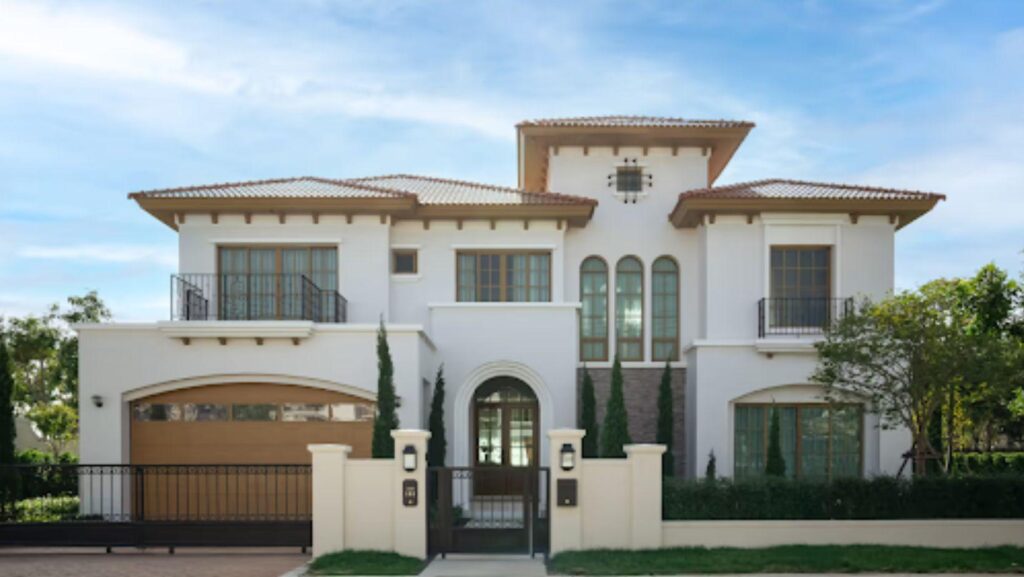
This is where planned townships have an advantage over a renovated older property, however well updated, cannot replicate on its existing plot. Families searching for a luxury house near Bangkok increasingly look at townships such as Reignwood Park in Lam Luk Ka, Pathum Thani, where larger plots, current-generation building systems, and a single masterplan grouping homes, a golf club, and an on-site international school all sit within one 2,000-rai (800-acre) site. For families who have already made peace with the idea of leaving a familiar postcode, that kind of combination changes what starting over actually looks like.
On-Site Amenities That Reduce Long-Term Trade-offs
One of the recurring frustrations families report after renovating an older property is that the finished home still requires driving elsewhere for a golf club membership, a place at an international school, or basic community facilities. Newer luxury developments north of Bangkok are increasingly built to remove that friction, bundling a golf course membership, an IB curriculum international school, and shared community space directly into the development itself, so that families relocating from established Bangkok neighborhoods are not trading convenience for space. For expat families in particular, having an accredited international school inside the community, rather than a long drive across the city, is often what settles the decision between renovating an existing home and moving somewhere new.
Making the Decision
There is no single figure that marks the exact point where renovation stops making financial sense. It depends on the age and condition of the existing structure, how much the original scope has already expanded, and how much the family values staying in a specific location versus gaining more space and updated systems elsewhere. What tends to be consistent is that the decision becomes clearer once a family adds up not just the renovation quotes already in hand, but the realistic cost of the next round of discoveries that inspection and demolition usually reveal. Resale value is worth factoring in as well, since a heavily renovated older home is still capped by its original lot size and neighborhood ceiling, while a newly built home in a planned community tends to hold its value differently as the surrounding infrastructure matures around it.
Weighing the Real Cost Before the Next Change Order
For homeowners currently weighing another change order against a fresh start, the most useful exercise is often the simplest one: tally every renovation cost incurred so far, estimate what remains, and compare that running total, plus the time still required, against what a newly built home in a well-planned community near Bangkok would cost to move into today. That comparison, more than any single line item, tends to reveal whether the current renovation still makes financial sense or whether it is time to look at what has already been built elsewhere.