
Hard water wreaks havoc on plumbing, leaves soap scum on fixtures, and shortens the life of water heaters and appliances. The fix lies in water softener media, the material inside the tank that does the actual work of removing calcium and magnesium ions. Most homeowners never look past the softener brand, but the media inside determines how well the system performs, how often it needs service, and how much salt it burns through. Understanding the differences between resin types, regeneration methods, and alternative media helps DIYers make smarter choices when installing or upgrading a system.
Key Takeaways
- Water softener media, typically ion exchange resin beads, removes hardness minerals through a reversible chemical process that lasts 10–20 years and requires only periodic salt refills.
- Standard 8% cross-link resin suits most households, while high-capacity or 10% cross-link resin reduces salt consumption and regeneration frequency for larger families or very hard water.
- Salt-free media like template-assisted crystallization (TAC) eliminates salt and wastewater but won’t remove soap scum and works best for moderate hardness under 20 grains per gallon.
- Choosing the right water softener media requires testing hardness, iron, and chlorine levels, then matching media type and tank size to household water use and demand.
- Extend water softener media lifespan by installing upstream sediment filters, using potassium chloride, running quarterly resin cleaners, and keeping inlet water below 120°F to prevent accelerated breakdown.
What Is Water Softener Media and How Does It Work?
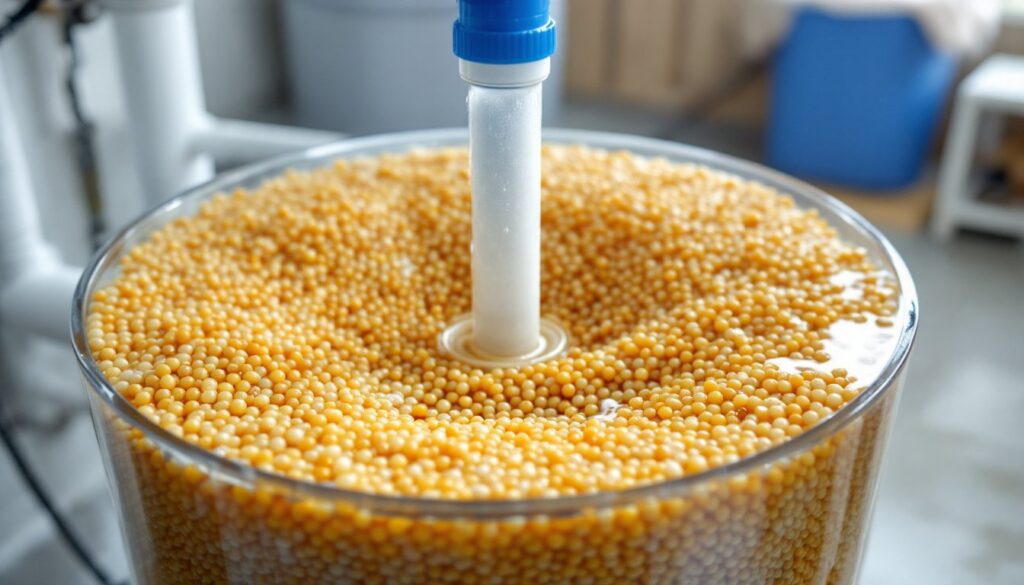
Water softener media is the material inside a softener tank that physically removes hardness minerals from water. The most common type is ion exchange resin, which looks like tiny amber or tan beads (about 0.3–0.6 mm in diameter). These resin beads carry a negative charge and are pre-loaded with sodium or potassium ions.
When hard water flows through the tank, calcium and magnesium ions, which cause hardness, stick to the resin beads. In exchange, the resin releases sodium ions into the water. This process is called ion exchange, and it’s reversible. Once the resin is saturated with hardness minerals, the system flushes it with a brine solution (salt water) during regeneration. The high concentration of sodium displaces the calcium and magnesium, recharging the resin so it can soften water again.
Resin beads sit in a tank above a distributor tube and are supported by a bed of gravel or an internal basket. Water enters at the top, passes through the media bed, and exits softened at the bottom. The entire process is mechanical and chemical, no filters to replace every month, just periodic salt refills and occasional media inspection.
Some systems use salt-free media that work differently. Instead of removing hardness, they crystallize minerals so they don’t stick to pipes. These are technically conditioners, not softeners, and they won’t eliminate soap scum or scale in the same way resin does.
Types of Water Softener Media: From Resin to Salt-Free Alternatives
Ion Exchange Resin Media
Standard cation exchange resin is the workhorse of most residential softeners. It’s made from polystyrene cross-linked with divinylbenzene (DVB), forming durable beads that last 10–20 years under normal conditions. Two main grades exist:
- 8% cross-link resin: The industry standard. It balances capacity, durability, and regeneration efficiency. Most softeners ship with this type.
- 10% cross-link resin: More rigid and resistant to physical breakdown, especially in systems with high flow rates or frequent cycling. It costs more but holds up better in demanding applications.
Resin capacity is measured in grains per cubic foot. Standard resin handles around 30,000 grains per cubic foot, meaning one cubic foot of media can remove 30,000 grains of hardness before regeneration. High-capacity resin pushes that to 40,000+ grains, reducing salt use and regeneration frequency.
Fine mesh resin (smaller bead size) increases surface area and improves efficiency in metered or on-demand systems. It’s common in premium softeners but can clog more easily if sediment isn’t filtered upstream.
Some resin is certified for potable water by NSF/ANSI Standard 61. If the softener treats drinking water, confirm the media meets this standard, especially when buying replacement resin.
Salt-Free and Alternative Media Options
Salt-free systems use template-assisted crystallization (TAC) media, often marketed under names like catalytic or nucleation-assisted crystallization. The media contains tiny beads coated with a polymer template that converts dissolved hardness minerals into microscopic crystals. These crystals stay suspended in water and pass harmlessly through pipes without forming scale.
TAC media doesn’t remove hardness, it just changes its form. Water test strips will still show high hardness levels. The benefit is no salt, no backwash, and no wastewater. It’s a good fit for eco-conscious homeowners or those on sodium-restricted diets.
Downsides: TAC systems don’t eliminate soap scum, and they lose effectiveness in very hot water (above 140°F). They also require pre-filtration to remove sediment and chlorine, which degrade the media.
Magnetic and electronic descalers are another alternative, but evidence of their effectiveness is inconsistent. They’re inexpensive and easy to install, but most plumbing professionals remain skeptical.
For water with iron or manganese, specialty resins exist. Standard softener resin can handle trace iron (under 0.3 ppm), but higher levels require iron-specific resin or a separate iron filter upstream. Iron-fouled resin turns brown or black and loses capacity quickly.
How to Choose the Right Water Softener Media for Your Home
Choosing media starts with understanding the water. Get a water test that measures hardness (grains per gallon or ppm), iron, manganese, pH, and chlorine. Most municipal water reports provide this data: well owners should test annually.
Match media to hardness level and household size. A family of four with moderately hard water (10–15 grains per gallon) does fine with standard 8% cross-link resin in a 1–1.5 cubic foot tank. Larger households or very hard water (20+ grains) benefit from high-capacity or 10% cross-link resin to extend time between regenerations and reduce salt consumption.
Flow rate matters. If the home has multiple bathrooms or high simultaneous water use, choose a softener with enough resin volume to maintain flow without bypassing untreated water. A rule of thumb: 1 cubic foot of resin supports roughly 10–12 gallons per minute (GPM). Undersized systems deliver hard water during peak demand.
Consider iron and chlorine. If iron is present above 0.3 ppm, use iron-out resin or add a pre-filter. Municipal water with chlorine can degrade standard resin over time: some manufacturers offer chlorine-resistant resin for city water applications.
Salt-free media works best when:
- Hardness is moderate (under 20 grains per gallon).
- The homeowner wants to avoid salt and wastewater.
- The home has a good sediment and chlorine pre-filter in place.
- Soap scum and lathering aren’t primary concerns.
Avoid salt-free systems if:
- Water is very hard (over 25 grains per gallon).
- The home has a tankless water heater (scale inside the heat exchanger is a real risk).
- Residents are sensitive to scale buildup or want the softest possible water.
DIY media replacement is possible but requires care. The tank must be drained, old media vacuumed out, and new resin poured carefully to avoid damaging the distributor tube. Wear gloves and a dust mask, resin dust irritates skin and lungs. Some homeowners hire a water treatment pro for media swaps: cost typically runs $200–$400 depending on tank size and local rates.
When buying replacement media, confirm it matches the tank diameter and volume. Overfilling reduces backwash space and causes resin to escape into the plumbing. Underfilling leaves the system undersized.
Water Softener Media Lifespan and Replacement Guidelines
Standard ion exchange resin lasts 10–20 years under ideal conditions, but real-world factors often shorten that. Chlorine, iron, sediment, and high water temperatures all accelerate breakdown.
Signs media needs replacement:
- Hard water breakthrough: Soap doesn’t lather, fixtures show scale, or test strips confirm hardness even after regeneration.
- Resin in faucet aerators: Tiny beads in the water indicate the distributor screen is damaged or the resin has degraded.
- Discolored resin: Brown, black, or green resin signals iron fouling, bacterial growth, or chlorine damage.
- Increased salt consumption: If the system regenerates more often without a change in water use, the resin may have lost capacity.
Extend media life by:
- Installing a sediment filter (5-micron or finer) upstream to catch sand, rust, and silt.
- Using potassium chloride instead of sodium chloride if city water contains chlorine, it’s slightly gentler on resin.
- Running a resin cleaner (like citric acid or a commercial iron remover) quarterly if iron is present.
- Keeping water temperature below 120°F at the softener inlet. Hot water accelerates resin breakdown.
TAC media has a shorter lifespan, typically 3–5 years, and must be replaced when water shows scaling again. There’s no regeneration: once the catalytic surface is spent, it’s done.
Disposal: Used resin is inert and can go in household trash in most areas, but check local regulations. Some water treatment companies accept old media for recycling.
Conclusion
Water softener media is the engine behind effective hard water treatment. Whether it’s traditional ion exchange resin or a salt-free alternative, the right media depends on water chemistry, household demand, and performance goals. Investing in the correct type, and maintaining it properly, means fewer repairs, lower operating costs, and reliably soft water for years.