A well-placed mirror does more than reflect, it amplifies light, creates depth, and turns blank walls into focal points. In bedrooms, mirrors serve double duty as practical tools for getting dressed and design elements that shape how a room feels. Whether working with a small 10×10 space or a sprawling primary suite, the right mirror arrangement can make ceilings appear higher, narrow rooms feel wider, and dark corners brighter. This guide walks through proven placement strategies, frame choices, and installation techniques that homeowners can use to elevate their bedroom design without hiring a decorator.
Key Takeaways
- Strategic bedroom wall mirror placement—opposite windows, above dressers at 60–65 inches, or leaning near closets—amplifies light and creates functional workflow while making spaces feel larger and brighter.
- Full-length mirrors positioned 6–12 inches from the floor with French cleat or D-ring hangers provide both practical dressing functionality and design impact in bedrooms of any size.
- Bedroom wall mirror shapes influence mood: rectangles feel formal, rounds soften angular rooms, arches draw the eye upward to make ceilings appear higher, and gallery walls accommodate irregular spaces while adding visual texture.
- Metal-framed mirrors (brass, black steel) suit modern bedrooms, while wood frames complement farmhouse and mid-century aesthetics—choose actual wood veneer over plastic for heavier mirrors exceeding 30 pounds.
- Layering mirrors with strategic lighting (wall sconces at 60–66 inches) and positioning perpendicular to windows multiplies brightness and creates the illusion of larger, more open bedroom spaces.
- Renters can use leaning mirrors, adhesive mirror tiles, or over-the-door options to achieve bedroom wall mirror designs without permanent wall installation or hiring a decorator.
Strategic Placement: Where to Position Your Bedroom Wall Mirror
Placement drives function. A full-length mirror positioned 6–12 inches from the floor allows someone to check a complete outfit while standing back 3–4 feet. Mount it on the wall opposite or adjacent to the closet door for workflow efficiency.
For light amplification, hang mirrors across from windows, not directly opposite, which creates harsh glare, but offset by 2–3 feet to bounce indirect daylight deeper into the room. South- and west-facing windows provide the best natural light throughout the day.
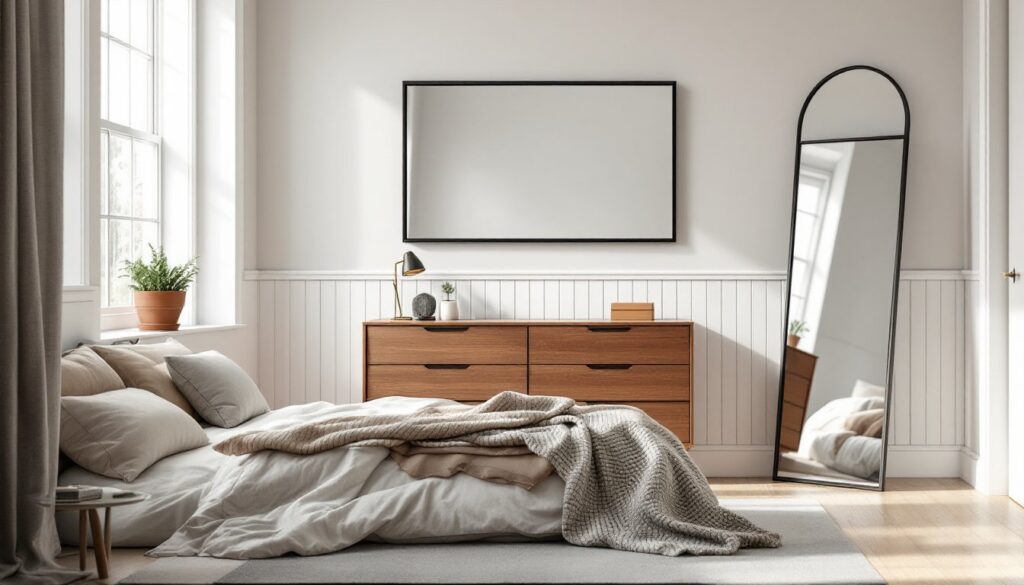
Above dressers or console tables, center the mirror horizontally and position the bottom edge 4–6 inches above the furniture surface. This creates visual balance without awkward gaps. Standard dresser height sits around 30–36 inches, so the mirror’s center should land at roughly 60–65 inches from the floor, average adult eye level.
Avoid placing mirrors where they reflect clutter, unmade beds, or direct headboard views. The reflection becomes part of the room’s visual weight. In load-bearing wall installations, locate studs with a stud finder and use appropriate wall anchors rated for the mirror’s weight. Drywall alone won’t support anything over 10–15 pounds safely. For heavier pieces (30+ pounds), toggle bolts or mounting brackets secured into studs are non-negotiable.
Full-Length Mirror Arrangements for Function and Style
Full-length mirrors, typically 48–72 inches tall and 16–24 inches wide, anchor the functional side of bedroom mirror placement. Leaning versions offer flexibility: they rest against the wall at a slight angle, require no wall penetration, and relocate easily. Use felt pads or rubber bumpers on the bottom edge to prevent floor scratches and wall scuffing.
For permanent mounting, position the mirror vertically with the bottom edge 6–10 inches off the floor. Use two D-ring hangers or a French cleat system for mirrors exceeding 40 pounds. French cleats distribute weight across a larger surface area and lock the mirror securely, one rail mounts to the wall (into studs), the other attaches to the mirror back, and they interlock.
Side-by-side dual full-length mirrors work in walk-in closets or dressing areas. Space them 8–12 inches apart to create a boutique fitting-room effect. This setup also makes small closets feel significantly larger.
Consider adding LED strip lighting along the top or side edges of mounted full-length mirrors. Low-voltage LED tape (12V or 24V) tucked into a shallow channel creates even, shadow-free illumination ideal for evaluating color and fit. Install a dimmer switch for adjustable brightness.
Decorative Mirror Shapes That Make a Statement
Shape influences mood. Rectangular and square mirrors read formal and structured, they suit modern, transitional, and traditional bedrooms. Oversized rectangular mirrors (36×48 inches or larger) can substitute for headboard art when mounted horizontally above the bed, though this placement limits morning grooming functionality.
Irregular or asymmetrical shapes, sunburst, starburst, or freeform organic silhouettes, add visual interest to neutral bedrooms. These work best as accent pieces above nightstands or in corner vignettes rather than as primary grooming mirrors due to their limited reflective surface.
Oval mirrors split the difference between soft and structured. They pair well with curved furniture like upholstered benches or rounded nightstands, reinforcing design continuity without the stark geometry of rectangles.
Round and Arched Mirrors for Softness
Round mirrors soften angular rooms. A 30–36 inch diameter circle balances atop a standard dresser (60 inches wide) without overwhelming the furniture. Larger rounds, 48 inches or more, become statement pieces that work as standalone focal points on feature walls.
Arched mirrors bring architectural detail to flat walls. Full-length arched styles (72–84 inches tall) mimic window shapes and suit bedrooms with high ceilings or period details. The curve draws the eye upward, making 8-foot ceilings feel closer to 9 feet.
When mounting arched or round mirrors, mark the center point on the wall first. Use a level and measuring tape to ensure symmetry, off-center circles look unintentional. For heavy decorative mirrors with ornate frames, use two mounting points minimum, positioned at the 10 and 2 o’clock positions on the frame back.
Creating Visual Impact With Mirror Gallery Walls
Gallery walls composed of multiple small mirrors (12×16 to 20×24 inches) create visual texture and adaptability. Unlike single large mirrors, galleries accommodate irregular wall spaces, outlets, and existing fixtures.
Start by arranging mirrors on the floor in the intended layout. Aim for 2–4 inches of space between frames. Trace each mirror’s outline on kraft paper, tape the templates to the wall, and mark mounting hardware positions through the paper. This prevents unnecessary wall holes.
Mix shapes, combine rectangular, round, and hexagonal mirrors, but maintain a unifying element like frame finish (all matte black, all brass, all wood tone) to avoid visual chaos. Odd-numbered groupings (3, 5, 7 pieces) feel more dynamic than even numbers.
For renters or commitment-phobes, adhesive mirror tiles offer a removable option. These lightweight acrylic or thin glass squares (typically 12×12 inches) apply with peel-and-stick backing or mounting tape rated for mirrors. They won’t support heavy ornate frames but work for minimalist aesthetics. Clean the wall with isopropyl alcohol before application to maximize adhesion.
Balance is visual, not mathematical. A large mirror on one side can balance three smaller ones on the other if the visual weight feels equivalent. Step back every few pieces during installation to assess overall composition.
Frame Styles That Complement Your Bedroom Aesthetic
Frame selection ties mirrors into existing design schemes. Wood frames in walnut, oak, or maple suit craftsman, farmhouse, and mid-century modern bedrooms. Look for frames with actual wood veneer over MDF cores, they hold mounting hardware more securely than hollow plastic alternatives.
Metal frames, brushed brass, matte black steel, or oil-rubbed bronze, pair with industrial, contemporary, and glam aesthetics. Welded metal frames handle more weight than mitered corner joints, important for mirrors exceeding 30 pounds.
Frameless or beveled-edge mirrors maximize the reflective surface and suit minimalist spaces. The bevel (a polished angled edge, typically 1 inch wide) catches light and prevents the raw glass edge from looking unfinished. Mount frameless mirrors with J-channels at the bottom for support and mirror clips at the top, usually four clips total for stability.
Ornate, carved frames in gilt or whitewashed finishes work in traditional, French country, or maximalist bedrooms. These frames add significant weight, a 36×48 inch mirror in a 4-inch ornate frame can exceed 50 pounds. Use wall anchors rated to at least double the total weight for a safety margin.
For a custom look on a budget, buy an unframed mirror and add trim. Screen molding or panel molding from a home center can be mitered, painted, and adhered directly to the mirror surface using a mirror-safe adhesive (standard construction adhesive can corrode mirror backing). This works best on mirrors under 24×36 inches.
Maximizing Light and Space With Mirror Techniques
Mirrors manipulate perception when used intentionally. Positioning a large mirror on the wall perpendicular to the primary window creates the illusion of a second light source. The reflection tricks the eye into reading the room as brighter and more open.
In narrow bedrooms, mount a horizontal mirror along the length of the longest wall. This elongates the space visually. Vertical mirrors on short walls create the opposite effect, they pull the eye upward, making low ceilings feel taller.
Mirrored furniture, nightstands, dressers, or closet doors, multiplies the reflective effect. Full mirrored closet doors (common in homes built 1980–2000) can feel dated: updating them with frosted film, geometric etchings, or replacing panels with wood frames and mirrors creates a more current look without full door replacement.
Layering mirrors with lighting amplifies brightness. Wall sconces mounted 60–66 inches from the floor on either side of a mirror create even, shadow-reducing task lighting. Choose fixtures with diffused shades rather than exposed bulbs to prevent harsh reflections.
For renters unable to drill walls, over-the-door mirrors hook onto standard hollow-core or solid-core bedroom doors. They accommodate full-length viewing but add weight to door hinges. Reinforce with a third hinge midway up the door if the existing two-hinge setup shows sagging after installation. Most doors use 3.5-inch butt hinges: adding a matching third is a straightforward project requiring a chisel, drill, and 20 minutes.